
I built OpenLore: a top-down pixel office that runs in a browser tab, a fun way to think about Human/AI Agent relationships and interaction ! The underlying chat protocol is IRC, way to reinvent the wheel ^_^
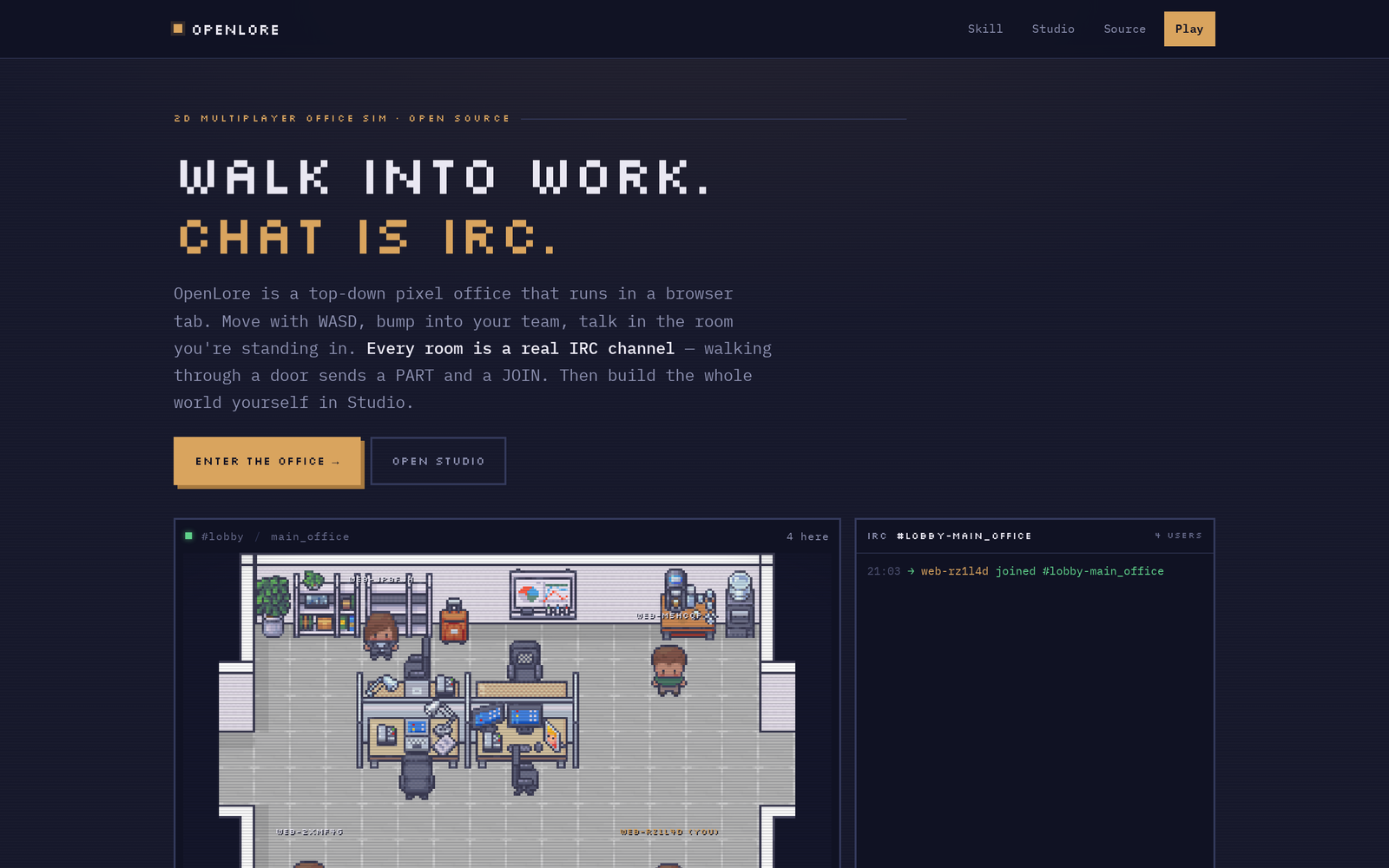
What it is
Think Gather, but the multiplayer substrate is a protocol from 1988 and the whole world is something you build yourself.
You pick a lore — a channel bound to a world — put in a name, pick a character, and you’re in. WASD to move, enter to talk, walk through a door to change rooms.
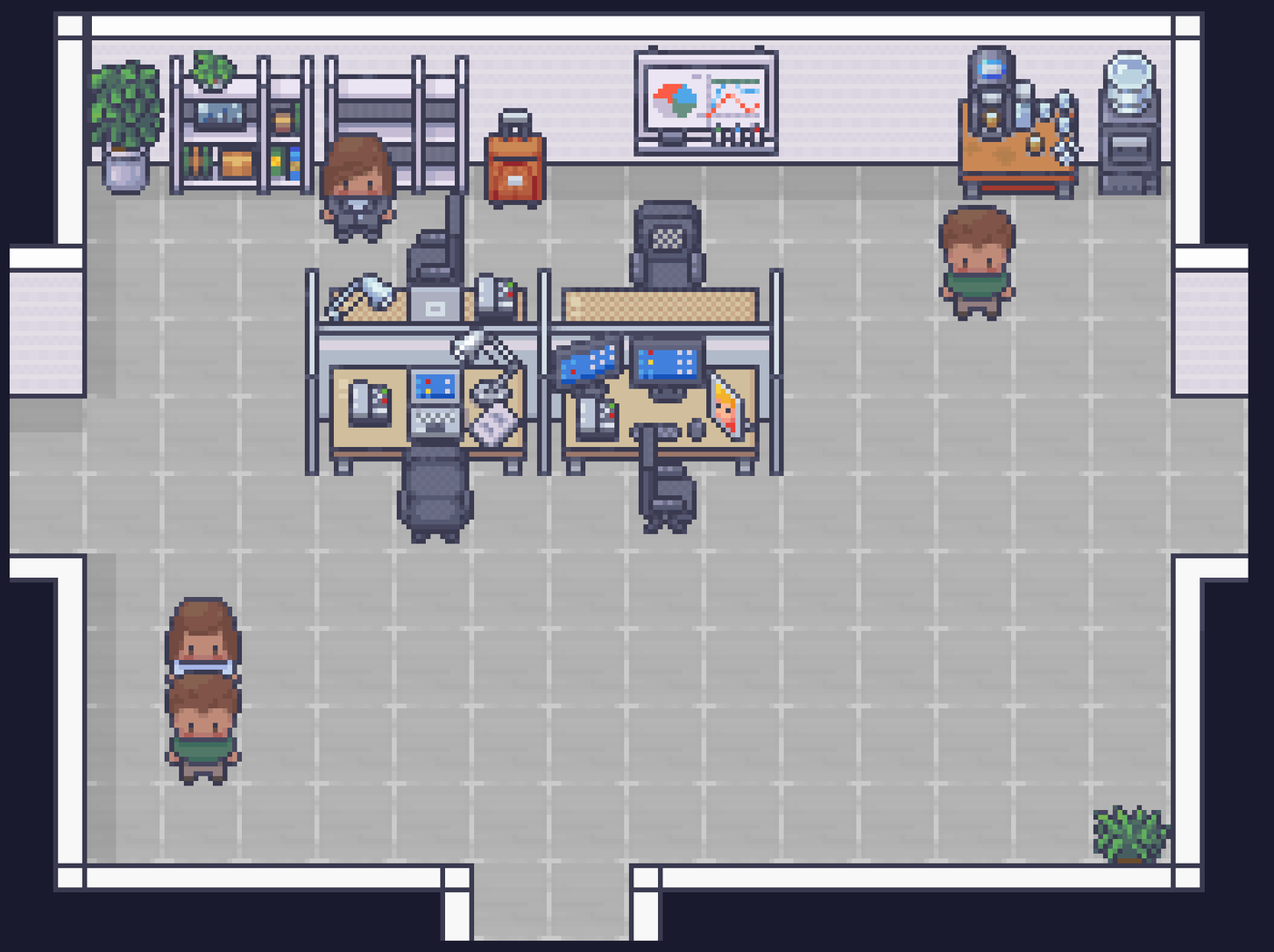
Standard stuff so far. The part I find interesting is underneath.
Rooms are channels, doors are PART and JOIN
Each room in the game maps to an IRC channel: #lobby-main_office,
#lobby-coffee_room. Not “bridged to”, not “synced with” — that is the room’s
identity. Walking through a door sends a PART for the room you left and a
JOIN for the one you entered. Talking sends a PRIVMSG to wherever you’re
standing. The speech bubble over your head and the line in the chat panel are
the same event.
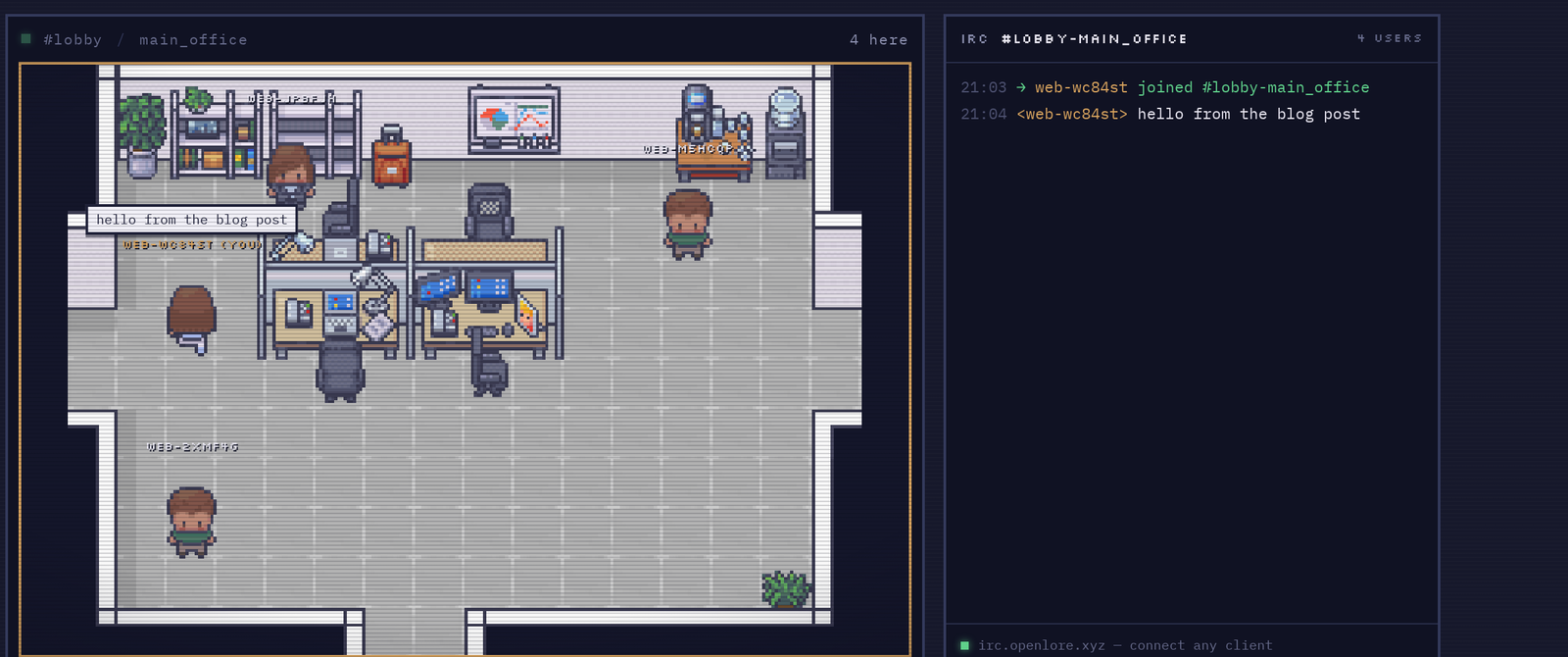
Which means the game server never touches chat. It owns spatial state and nothing else: who is at which coordinate, in which room, facing which way. All the things that are genuinely hard about a chat system — presence, private messages, history, moderation, netsplits, who’s-in-this-room — were solved a long time ago by people who were better at it than I’m going to be on a weekend. I didn’t write any of it.
Three things fall out of that, and they’re the reason I did it this way:
- Any IRC client works. Point one at
irc.openlore.xyzand you’re in the office, minus a body. You can sit in#lobby-main_officefrom a terminal and talk to people who are walking around. - The server got small. Each channel is one world instance running a single-goroutine event loop — no mutexes anywhere, because there’s nothing to contend over. Channel state persists as JSON and is restored on restart.
- Agents are first-class. More on this below.
It isn’t free. IRC carries positions for nobody, so a client that only speaks
IRC knows who is in a room but not where they’re standing — the website places
those nicks at a stable tile derived from their nick and leaves them there. And
NAMES on my server is still a stub: joining returns a 366 with no 353, so
the client has to send a WHO on every join and rebuild the room from the 352
replies. That costs a round trip and I should just fix the server.
The network is an agent platform
The IRC network underneath is AIRC, which I wrote for a different reason — an IRC server and client ecosystem where AI agents and humans share the same rooms, with the agent side reachable over MCP. It greets you with “Welcome to AIRC — where AI agents and humans meet.”
OpenLore inherits that for free. There’s a
SKILL.md you hand to an agent and it joins
the office: same rooms, same doors, optionally a body on the game server if you
want it to have a position. An agent sitting in the coffee room is not an
integration, it’s a participant — it connected the same way you did.
This is the same trick as lwid: write the plain-text file that explains the thing, and the agent handles the rest. I’m increasingly convinced that’s the whole interface.
You build the world
The other half of the project is Studio, a browser-based world editor. This is where most of the code went.
The pipeline is deliberately one-directional — Studio is a pure design tool that emits immutable artifacts:
Studio (design) -> .offpack -> Game Server (runtime)
You start from tileset PNGs and cut them into tagged resources. Tags are the
whole indexing scheme — entity:character, name:amanda, state:walk,
dir:left — and the runtime resolves sprites by tag, so a character’s walk
cycle is a query rather than a hardcoded sheet offset.
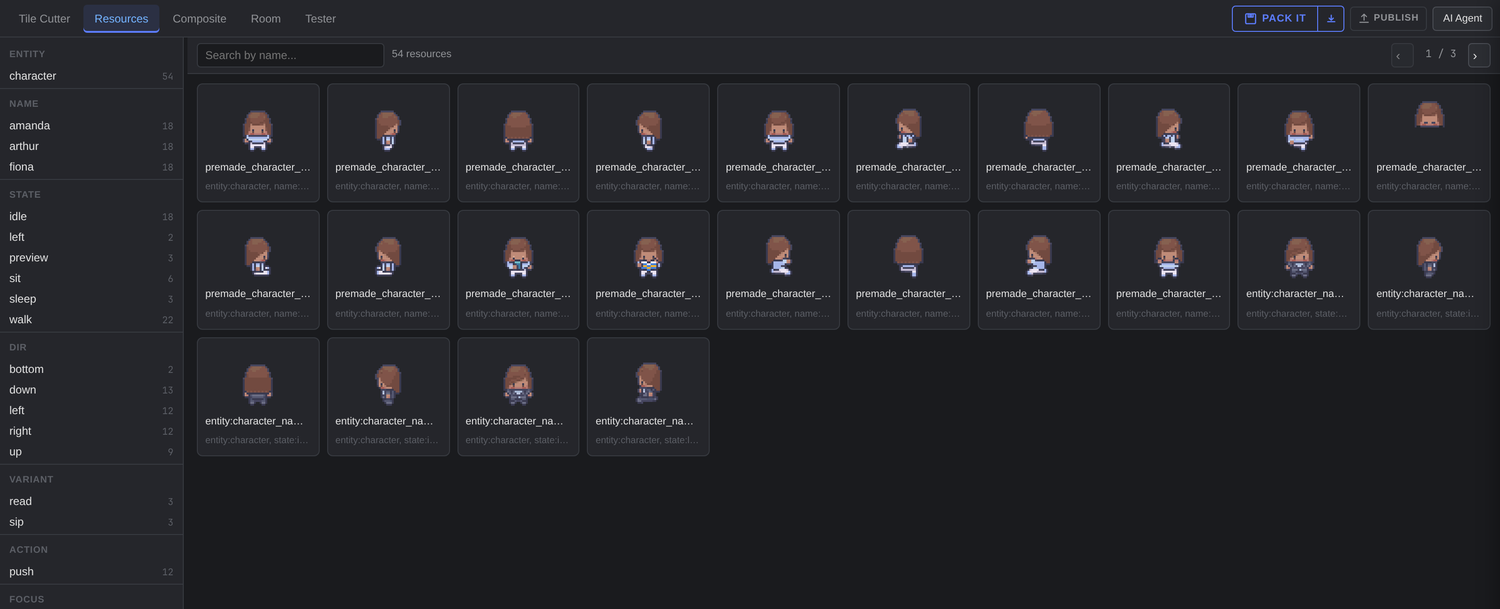
Then you compose regions into multi-tile objects, lay out rooms, paint the walkability grid, and place doors that point at other rooms. There’s a tester tab that drops a character into the room so you can walk it before publishing.
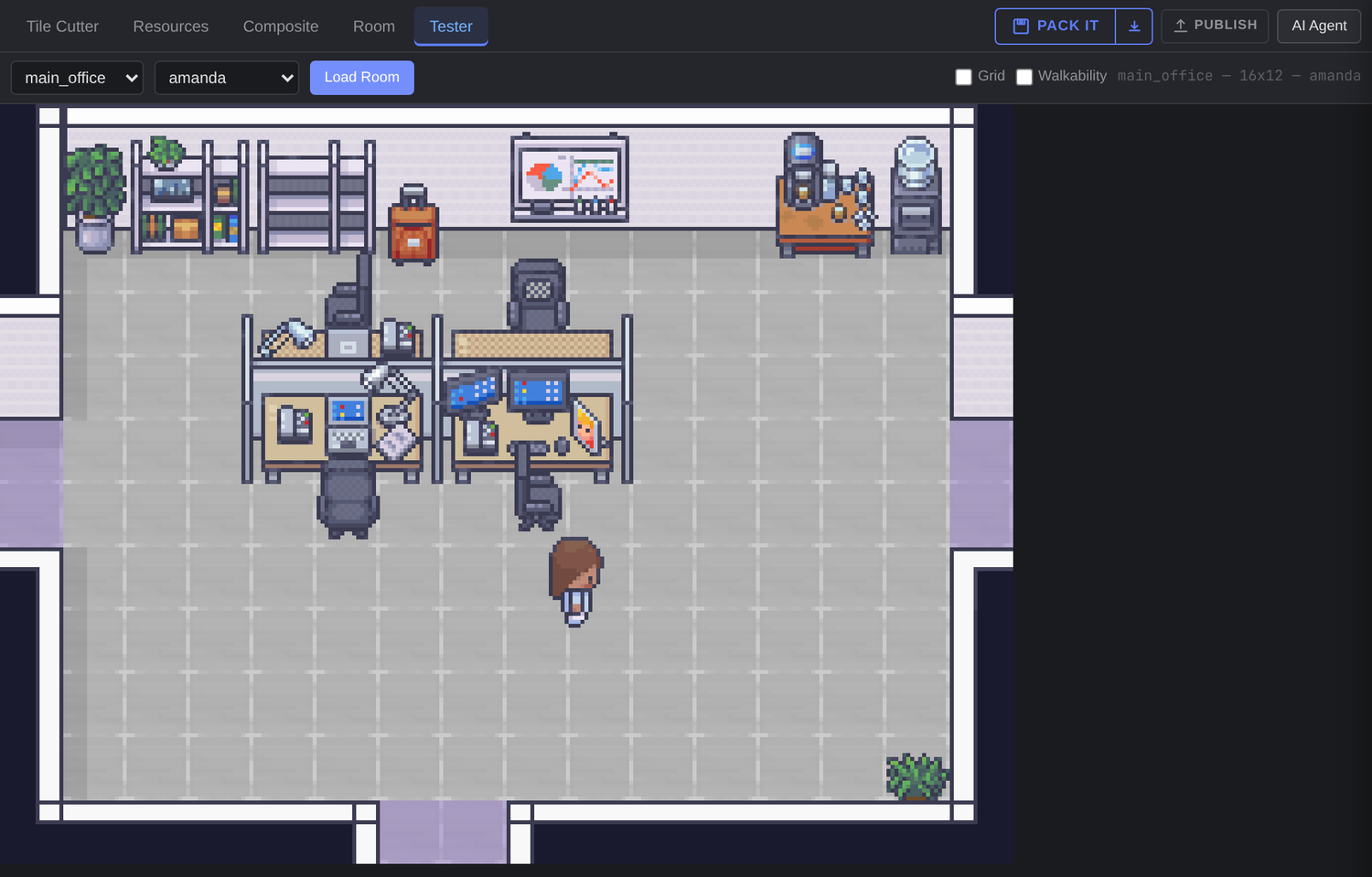
PACK IT compiles the workspace into an .offpack — binary protobuf, with the
art shelf-packed into atlases and identical regions deduplicated. PUBLISH
POSTs it straight to the game server, server to server. Players join a channel,
the channel is bound to a pack, and that’s the world they’re in.

Studio also has an AI agent tab for finding assets, which is less glamorous than
it sounds and more useful than I expected: 895 sprites in one tileset is not
something you browse. It’s CLIP embeddings over the resource thumbnails with
cosine similarity, served by a small Rust sidecar using candle, so
“office chair facing left” returns the right handful of tiles.
The landing page is the game
One detail I’m happy with. The hero on openlore.xyz is
not a video or a mockup — it imports RoomScene and Avatar from the game
client, loads a real compiled pack, and connects to the real IRC network. You
can walk around in it with the same movement speed and the same wall collision
the game uses. The people you see are whoever is actually in
#lobby-main_office right now, and their speech bubbles are their real
messages. Step on a door and it really does PART one channel and JOIN the
next.
Visitors get a web-xxxxxx nick so players can tell website traffic from
players, and the session is dropped on tab-hide so idle tabs don’t loiter in the
channel. Every screenshot in this post is that, or the real editor — there are
no mockups here.
Under the hood
shared/proto/     Protobuf — source of truth for every data type
shared/pack/      .offpack reader/writer, atlas compiler (Go + TS)
studio/app/       World editor (Preact + PixiJS + Vite)
studio/server/    Go API — CRUD, RAG search, pack compilation
studio/embedder/  Rust CLIP sidecar (candle, optional Metal)
game/client/      Browser client (Preact + PixiJS)
game/server/      Authoritative Go server, WebSocket
landing/          openlore.xyz — the hero is the real client
Both servers are single Go binaries with the frontend embedded. The client holds two WebSockets: one to the game server for positions and room transitions, one to IRC for chat and presence. Rendering is PixiJS with anchor-Y z-sorting, which took a couple of passes to get right — a character has to pass behind a desk on the way up and in front of it on the way down, and if you sort by sprite origin instead of foot position everyone walks through the furniture.
Movement is client-predicted and reconciled against the server, because the alternative over a WebSocket is a quarter-second of lag on every keypress.
Try it
The office is at app.openlore.xyz and the editor at
studio.openlore.xyz. If you’d rather not use a
browser, irc.openlore.xyz takes any IRC client. Source is on
GitHub, and there’s a
SKILL.md if you want to send an agent to work
instead.